Q&A with David Coggins
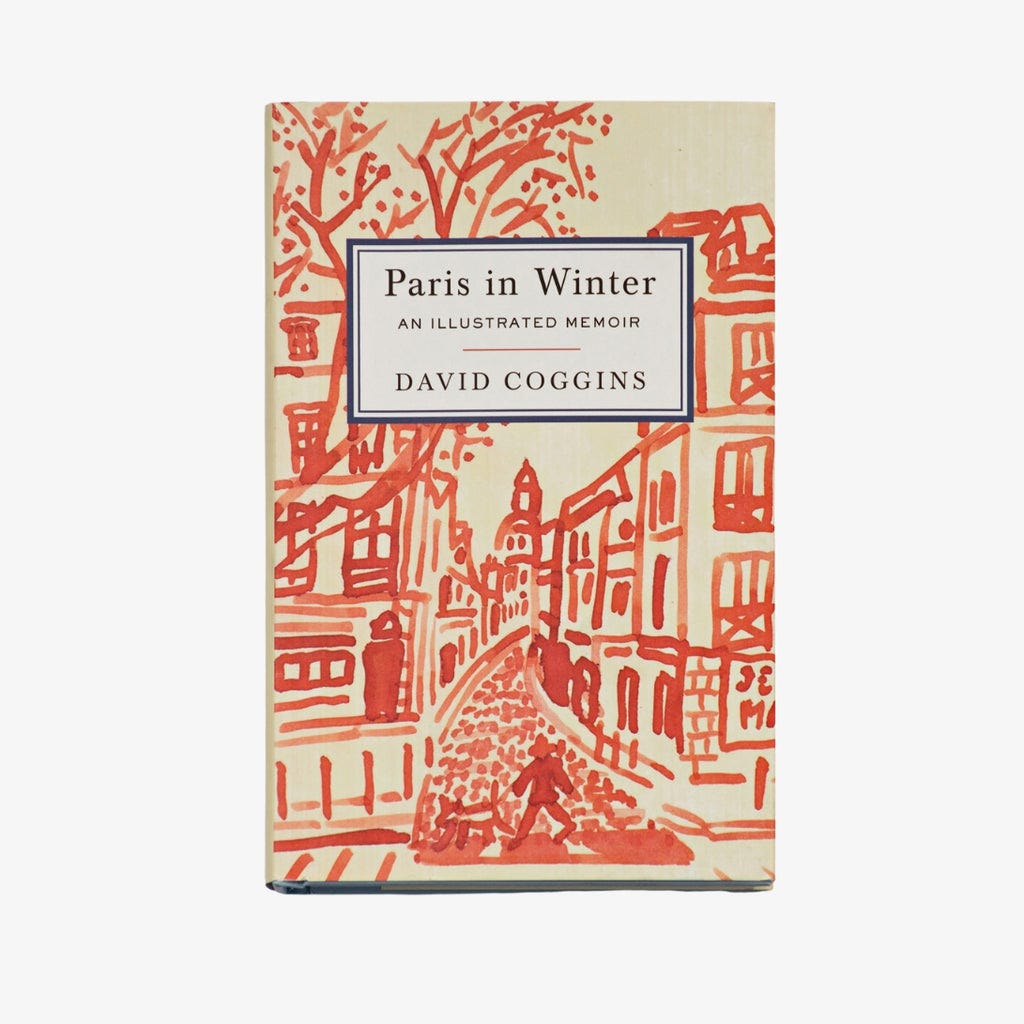
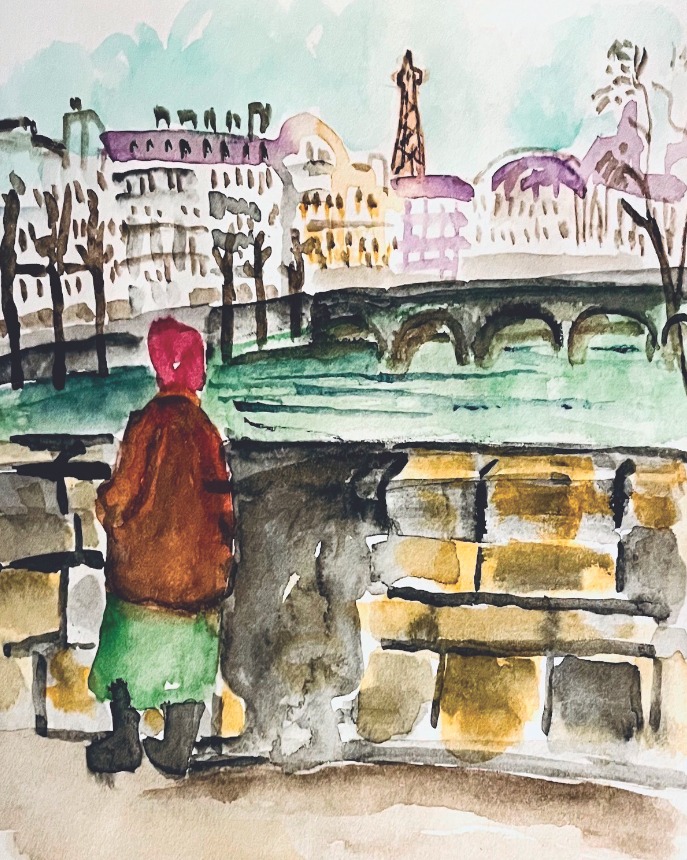
I first learned about David Coggins through my aunt Laurie who gifted me his illustrated memoir, Paris in Winter, shortly after it came out. Little did I know just how much I would lose myself in his lyrical language and lighthearted watercolor illustrations. The book chronicles decades of the author’s New Year’s sojourns to the city with his family — the poetic vignettes are both charming and heartwarming. I often think about his beautiful stories, like his wife, Wendy, telling their children she loved them “across the white table and the forest of wine glasses,” or the hot wine with cinnamon he sipped at Le Petit Saint Benoit, or the way their son spelled out “merci” in frites on his plate. I can picture him and his family walking in their “fancies” to lunch at Le Grand Vefour, Wendy wearing her silver shoes with ribbons around the ankle, or circling the Place Vendome after dark. I agree with his sentiment that the square “would make a great outdoor ballroom. People could dance to a Chopin mazurka, minding the cobblestones of course…” Whenever I get nostalgic for Paris and her food, fashion, and art (which admittedly is often) I find myself picking up David’s book and teleporting there, if just for a moment or two…
- Where are you from and what has your professional career looked like over the years?
I lived in Greece as a boy and in Holland in the early years of my marriage, which instilled a love of travel and an interest in other cultures. I started out as a writer after college with a strong interest in painting and drawing. There’s an unpublished novel somewhere in a studio drawer. I’ve worked in many art forms, including collage, photography, and set design as well as painting and drawing. I’ve also made many limited edition “artist’s” books.

2. I’m curious how the combination of both text and illustration comes together to help tell your stories. Can you share more about your process and how these memoirs came to be?
I’ve made drawings and kept notes whenever I traveled, and took many photographs which I use as reference. It seemed natural to combine my passion for writing, art, and travel when I decided to do memoirs. I have traveled for many years with my family to Paris and St. Barts. They seemed logical choices for memoirs about foreign places and family.

3. Do you paint purely in watercolor? What is it about the medium that lures you?
I use watercolor and inks for the illustrations in my books. Both are portable and dry quickly. They lend an extra, and I hope light-hearted, dimension to my books. I have always enjoyed travel watercolors by other artists like Turner and Delacroix.
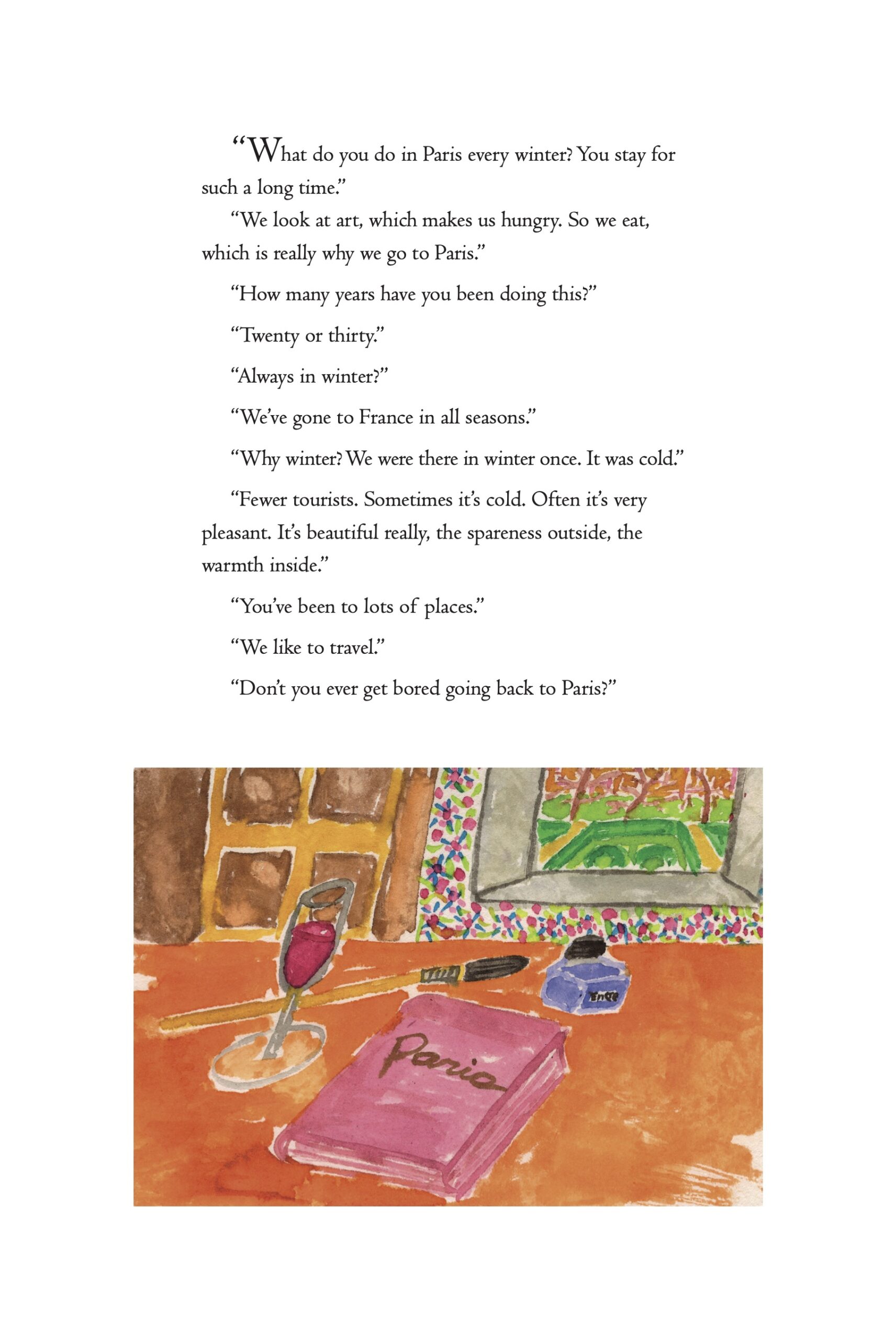
4. Do you split your time between Minneapolis and anywhere else? How often are you on the road today traveling?
I spend summers at our hundred-year old cabin on a beautiful lake in Wisconsin. I built a studio 25 years ago on a hill overlooking the lake and work there almost every day. We travel to Europe every winter for the month of January to get away from cold Minnesota, and again somewhere warm in late winter. We often take trips to other countries in summer and fall, like Norway, Portugal, and Morocco.

5. Please share a bit about your studio. From the bits of I’ve seen, it appears like an Aladdin’s cave, brimming with treasures and foraged items. What are some of your favorite things you’ve found and collected over the years, and a few things you’d grab in the event of a fire?
I have been in my Minneapolis studio for 30 years. It’s a 3,000 square foot space in a former warehouse built in 1910. Spaced along the old brick walls are nine arched windows looking out at the Mississippi River and the city. It’s filled with antique and vintage furniture and objects collected in the US and abroad (an Indonesian doll, a large antique French palette, two grand red Chinese chests), and hundreds of books. Lanterns from Syria and Marrakech, masks, and the taxidermy are some of the things I especially like. I think my artist’s books are what I’d grab first if there were a fire. They’re one of a kind.

6. As you look back on your extensive travels, what are a few superlative memories you’d cherry pick from your life?
- Attending a summer chamber music festival on the beautiful islands of Lofoten, Norway where concerts are given in old wooden churches. We stayed in a restored fisherman’s hut that jutted out over the water.
- Having an annual family lunch in Le Grand Vefour (when the restaurant was in its prime) and strolling afterward through the gardens of the Palais Royal and the Tuileries.
- Visiting the ancient burial grounds of Saqqara in Egypt.
- Having dinner with Russians in a communal apartment in Leningrad in the early 70s.
- Taking Le Train Bleu (after having dinner in the wonderful art nouveau restaurant in the Gare de Lyon) to Nice in celebration of my wife’s 40th birthday.
- Visiting Machu Picchu in Peru with my son when he was still in college and being with my daughter when she enrolled at the Parson School of Design in Paris.
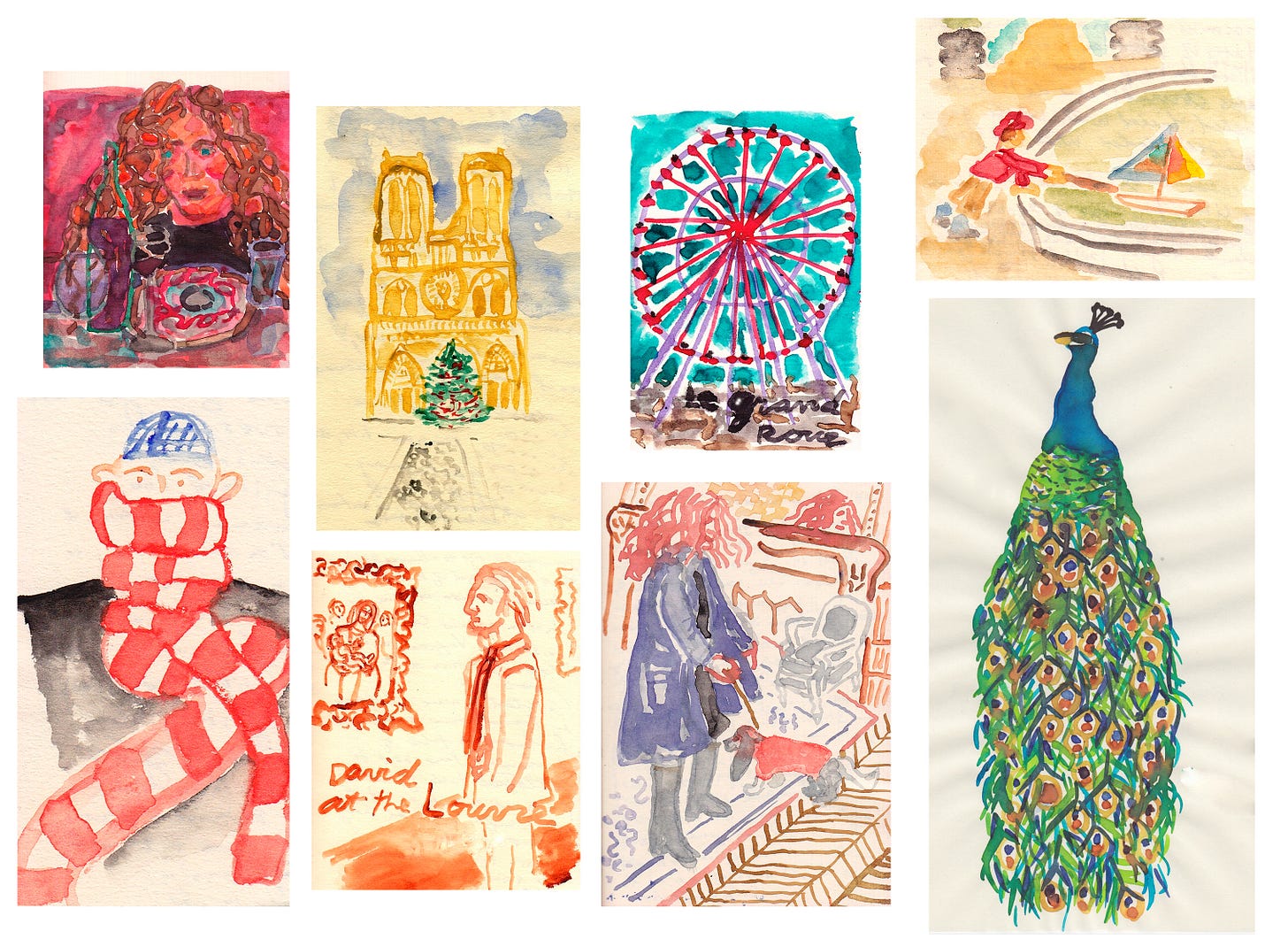
- I know you’ve called Paris your favorite city and your annual winter sojourns there over twenty years became the focus of your book. For those who haven’t read it, please share what the city means to you and how it makes you feel. What is it about Paris, as opposed to other places, that makes it your favorite to return to, particularly when cloaked in winter?
Paris, as many people claim, is arguably the most beautiful city in the world. Everybody knows about its cafes and restaurants, its style and fashion, its museums, churches, gardens. In winter, it’s more intimate and less filled with tourists. It’s a wonderful place to walk especially in quiet hours and in quiet neighborhoods. Over the many years we have been to Paris, we have come to know it well. It’s a place of great comfort and pleasure; there’s a sense of occasion in the simple routines and outings of daily life. We have our favorite restaurants where we often go with French friends. We know servers in cafes and shopkeepers in the bakeries and grocery and flower shops. Parisians will embrace you if you are friendly and polite, especially once they get to know you.
8. What does a perfect day there look like for you?
We rent apartments in the 6th arrondissement on the Left Bank usually near rue du Bac and rue de Grenelle. Special things to do in Paris include going to a candle-lit piano recital in the tiny Saint-Ephrem-le-Syriaque church in the 5th arrondissement. Browse Galignani, a beautiful bookstore on rue de Rivoli, and then go to Le Dali in the Hotel Meurice next door for lunch. Take in a performance of Cirque Romanès in the 16th. Walk in any of the beautiful gardens and squares: Jardin du Luxembourg, Place des Vosges, Palais Royal, Parc Monceau. Check out antique shops in the 7th. Go to the Puce de Vanves flea market and to the organic fruit and vegetable market on Blvd. Raspail on Sundays.
9. If you were to pick just one or two memories from all your charming vignettes in the book, which would be a favorite, or perhaps one that sparkles for you right in this moment?
Special memories from the book center around ritual family meals at Le Grand Vefour and Le Voltaire, where we knew the staff and were always warmly welcomed. Alas both restaurants have changed over the years and are not quite the same as they used to be.
10. Tell us a bit about writing Paris in Winter – did the idea for a book come after years of doodling and writing in journals? Or was it always the plan?
After filling many notebooks with watercolors and notes, putting it all into a book seemed a logical thing to do. It was not always the plan. The idea for Paris in Winter was more or less a spontaneous idea, though it took a long time to put it all together. We have gone to Paris every year (except during the pandemic) for 30 years. Blue: A St. Barts Memoir seemed a natural follow-up to Paris in Winter. I kept notes and made watercolors over the many years we went to St. Barts.

11. Which artists and writers do you most look up to and admire?
Favorite artists are many, including Titian, della Francesca, Manet, Braque, Matisse, Schwitters, Twombly, Sonia Delaunay, Agnes Martin. Favorite writers include Hemingway and Fitzgerald, John Banville, Bruce Chatwin, Virginia Woolf, Susan Sontag. Chatwin’s In Patagonia had a big impact on me. Favorite filmmakers are Hitchcock and Wes Anderson, Truffaut, Fellini, and Paolo Sorrentino.

12. Finally, is there any advice you would give, or words of wisdom for those reading who might be taking on a creative project this year?
Read, look at art, listen to music, watch good films and go to good theater, travel. Immerse yourself in the past and the present, figure out what interests and excites you. Write or paint every day, develop discipline, keep editing, rewriting, keep turning things around in your head. Eat well, go for walks, be grateful.